Why the Fastening Method Matters More Than You Think
Most contractors pick an insulation fastening method early in their career and stick with it. Tie wire because that is what the foreman used. Tape because it was in the truck. Stick pins because the supply house had them in stock. But the method you use to secure duct wrap insulation directly impacts four things that affect your bottom line: labor hours per job, callback risk, crew safety, and air leakage performance.
This article compares the five most common methods side by side so you can make an informed decision for your crew. We manufacture Zip-Ez Insulation Fasteners, so we are not pretending to be neutral — but the comparison data is real, and we will give you an honest assessment of every option.
The Comparison Table
| Factor | Zip-Ez | Tie Wire | Foil Tape Only | Stick Pins + Clips | Adhesive Spray |
|---|---|---|---|---|---|
| Installation Speed | Fastest — one hand, one drill, one motion | Slowest — wrap, twist, cut, repeat | Moderate — but tape sticks to gloves | Slow — pre-apply pins, then clip after wrapping | Fast initial tack, but dry time adds up |
| Hands Required | One | Two | Two | Two (pin step + clip step) | One (spray), then two (press) |
| Long-Term Hold | Permanent mechanical lock | Good if twisted tight | Adhesive degrades over time | Depends on pin adhesive bond | Fails in high heat or humidity |
| Air Leakage | Zero — Duct Blaster tested at 25, 50, 100Pa | Minimal — no penetration, but no seal either | Depends on tape adhesion quality | Pin penetration point may not self-seal | No penetration, no seal |
| Crew Safety | No sharp edges, no cuts | Cut hands, bloody gloves, sharp twisted ends | Safe | Pin points can puncture skin | Fumes in enclosed spaces |
| Works on Duct Wrap | Yes | Yes | Marginal on heavy rolls | Yes | Yes, but weak on thick rolls |
| Works on Rigid Foam Board | Yes | No — wire crushes foam | No structural hold | Yes, if pins adhere to surface | Temporary tack only |
| Works on Reflective Insulation | Yes | Tears easily | Yes, but adhesion varies | Yes | Yes |
| Special Tools Needed | Battery drill (already on your truck) | Wire cutters, pliers | None | None | Spray gun or can |
| Certifications | Duct Blaster Tested, GreenSpec Listed | None | UL 181 rated tapes available | None standard | None standard |
Breaking Down Each Method
Tie Wire
Tie wire is the old-school standard. It works — no one disputes that. You wrap wire around the duct and insulation, twist it tight with pliers, and cut the excess. The insulation stays put.
The problems are all in the process. Tie wire requires two hands, which means you cannot hold insulation in place while you fasten. On overhead runs, you need a second person or you fight gravity the entire time. The wire cuts through standard work gloves within hours. Every insulation crew that has used tie wire all day knows the bloody hands, the nicks on the forearms, and the sharp twisted ends left behind that catch you on every return trip through the mechanical space.
On labor cost, tie wire is the most expensive fastening method per linear foot — not because the wire itself costs much, but because the labor time per fastener point is the highest of any method.
Foil Tape Only
Some crews skip mechanical fastening entirely and rely on foil tape as both the seal and the fastener. On light-duty residential work with thin duct wrap, this can look fine on day one. The problem is longevity. Tape adhesive degrades in high-temperature environments — and the space around supply ductwork is exactly that. Within two to five years, you see sagging insulation on horizontal runs and peeling seams on vertical risers.
Foil tape is essential for vapor barrier sealing. It is not a structural fastener.
Stick Pins and Speed Clips
Stick pins are adhesive-backed metal pins that you press onto the duct surface before wrapping. After the insulation is in place, you push a speed clip over the protruding pin. This method works when the adhesive bond holds — which depends on the duct surface being clean, dry, and at the right temperature. On oily or dusty ductwork, pins release. In high-heat environments, the adhesive softens.
The two-step process (apply pins first, then clip after wrapping) adds time. And unlike a screw-driven fastener, a stick pin has no mechanical connection to the duct itself. If the adhesive goes, everything goes.
Adhesive Spray
Contact adhesive spray gives a fast initial tack. You spray the duct, spray the insulation, wait for the adhesive to get tacky, then press the insulation into place. It works for temporary positioning, but it is not a permanent structural hold on duct wrap. In hot attics and mechanical rooms, the adhesive softens. In cold environments, it can become brittle. And in enclosed spaces, the fumes are a legitimate health concern for your crew.
Zip-Ez Insulation Fasteners
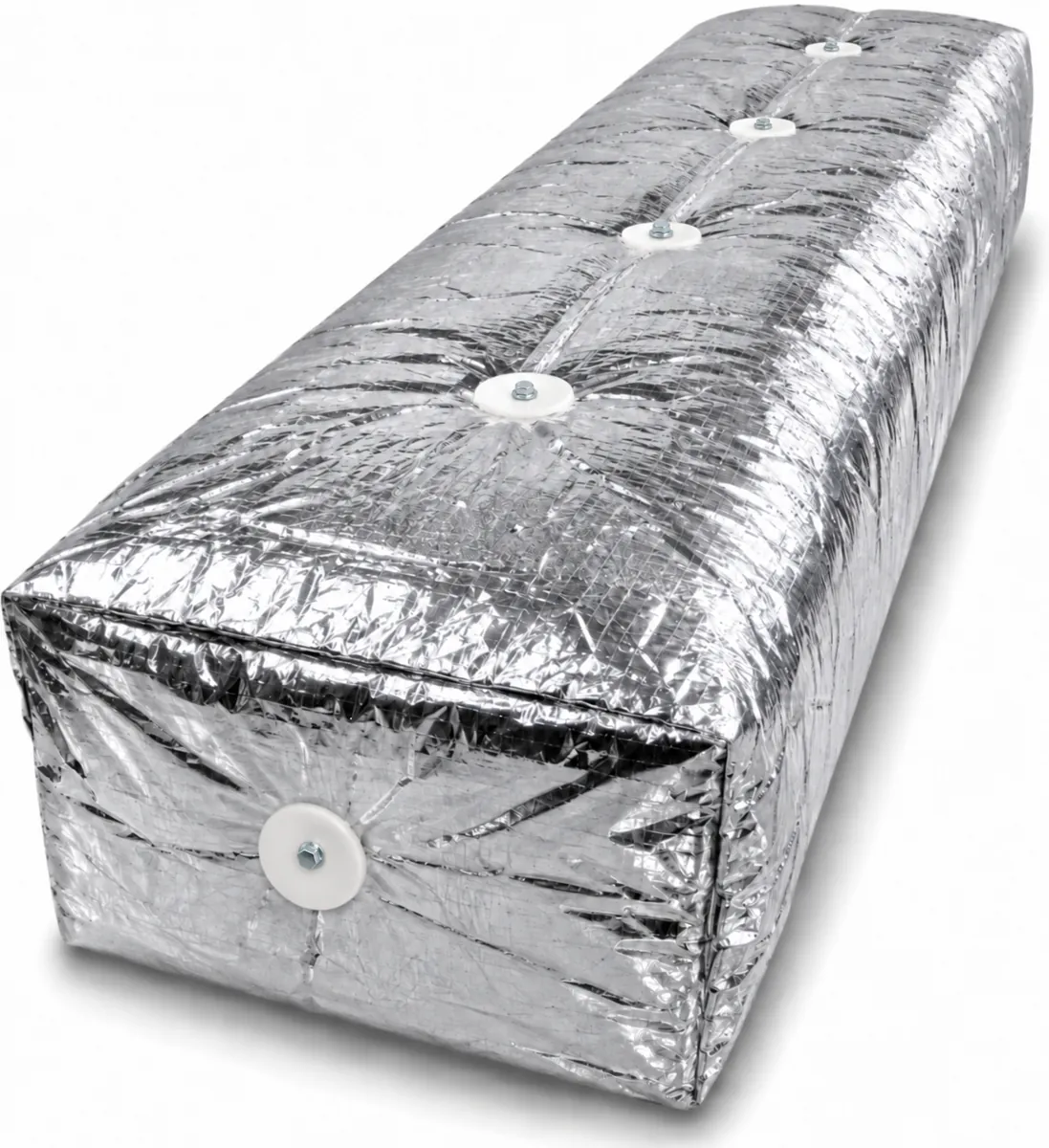
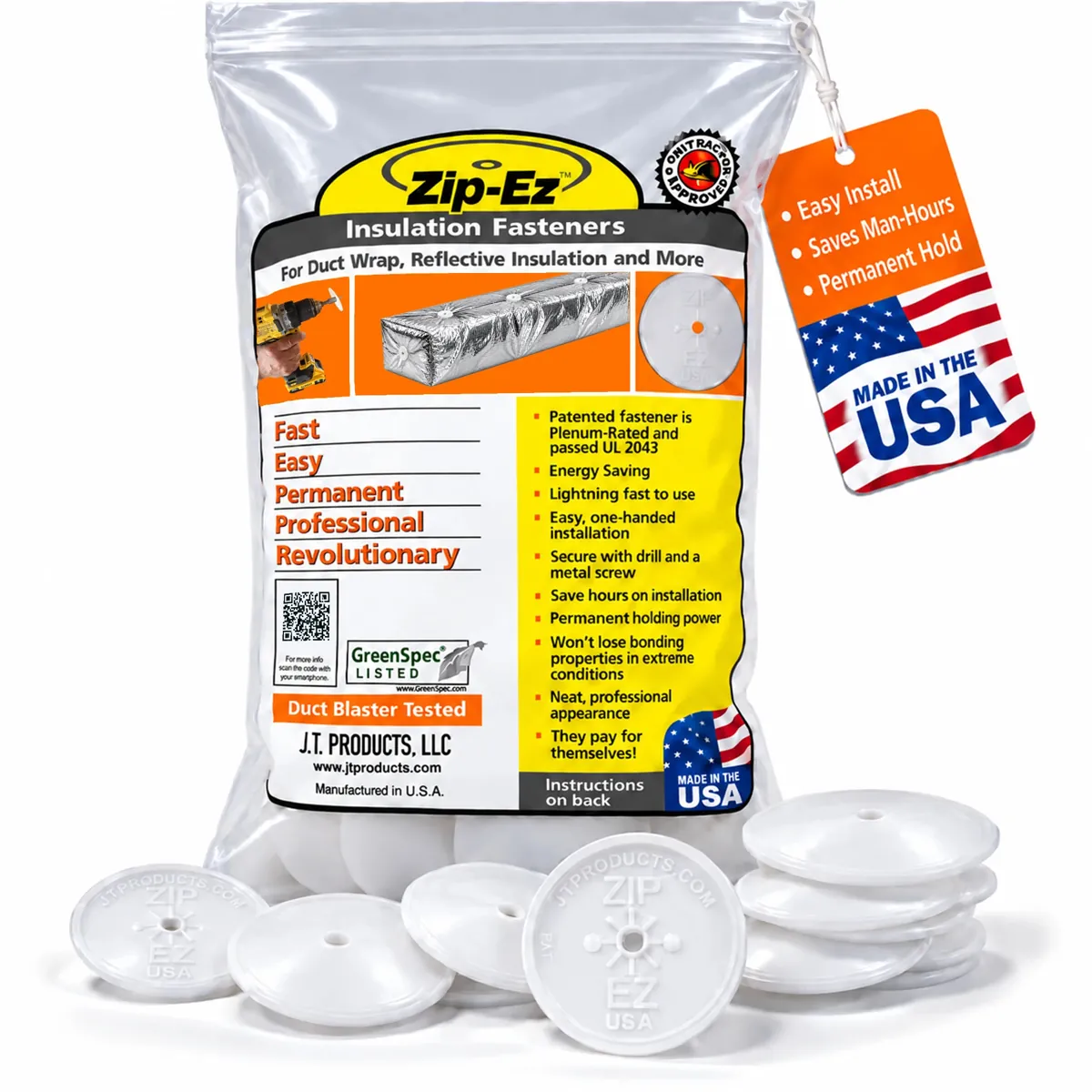
Zip-Ez is a mechanical fastener that slips over any standard sheet metal screw. You position it on the insulation overlap, drive it with your battery drill, and the fastener self-inverts to create a flush, permanent clamp. One hand, one tool, one motion per fastener point.
Because it drives through the insulation and threads into the duct metal, the connection is purely mechanical — no adhesive to fail, no wire to twist. The screw threads are self-sealing, which is why Zip-Ez passed the Duct Blaster test with zero measured air leakage at any pressure level tested (25Pa, 50Pa, 100Pa).
Zip-Ez also works across all insulation types: duct wrap, reflective insulation, and rigid foam board. One fastener system covers every job type, which simplifies what your truck carries and what your crew needs to learn.
The Duct Blaster Test
Air leakage is not just an efficiency concern — on many jobs, it is a pass/fail inspection item. Zip-Ez fasteners have been independently tested by a BPI-certified HERS Rater using a Minneapolis Duct Blaster at three pressure levels. The result at every level: zero measured or visible air leakage at any fastener penetration point.
No other common insulation fastening method has published duct blaster test data. If your jobs require duct leakage testing (increasingly common in energy-code-compliant jurisdictions), this data gives you documented proof that your fastening method does not contribute to leakage. Read the full test report here.
GreenSpec and AHR Expo Recognition
Zip-Ez Insulation Fasteners are GreenSpec listed in the BuildingGreen sustainable product directory, which may contribute to LEED points on commercial and green building projects. The product has also been featured at the AHR Expo at Javits Center in New York City — the world's largest HVAC&R exhibition — in partnership with Johns Manville.
For contractors bidding on projects where sustainability certifications or green building credits matter, these listings provide documented third-party recognition that other fastening methods do not have.
What Contractors Are Saying
"These are not the cheapest insulation fasteners but they are tough. I have not broken one yet and they work great. They invert when you tighten them — then they are flush with the insulation surface."
"They are a super great product. Our installation technicians are using them on almost every job and they love them!!!"
"Ordered these for a HVAC company and they were exactly what we needed. The shipping was on time. I would order from JT Products again."
The Bottom Line
Every fastening method will hold insulation on a duct — at least on day one. The differences show up in labor time, crew wear and tear, long-term durability, and performance under testing.
If you are running a production shop where labor hours directly impact your margin, or if you are bidding commercial work where duct leakage testing and green building certifications are part of the spec, Zip-Ez gives you documented advantages that other methods cannot match.
If you want the full installation walkthrough, see our complete duct wrap installation guide.
Try Zip-Ez on Your Next Job
Available at HVAC distributors nationwide and on Amazon. Approximately 250 fasteners per bag.
Find a Distributor Buy on Amazon